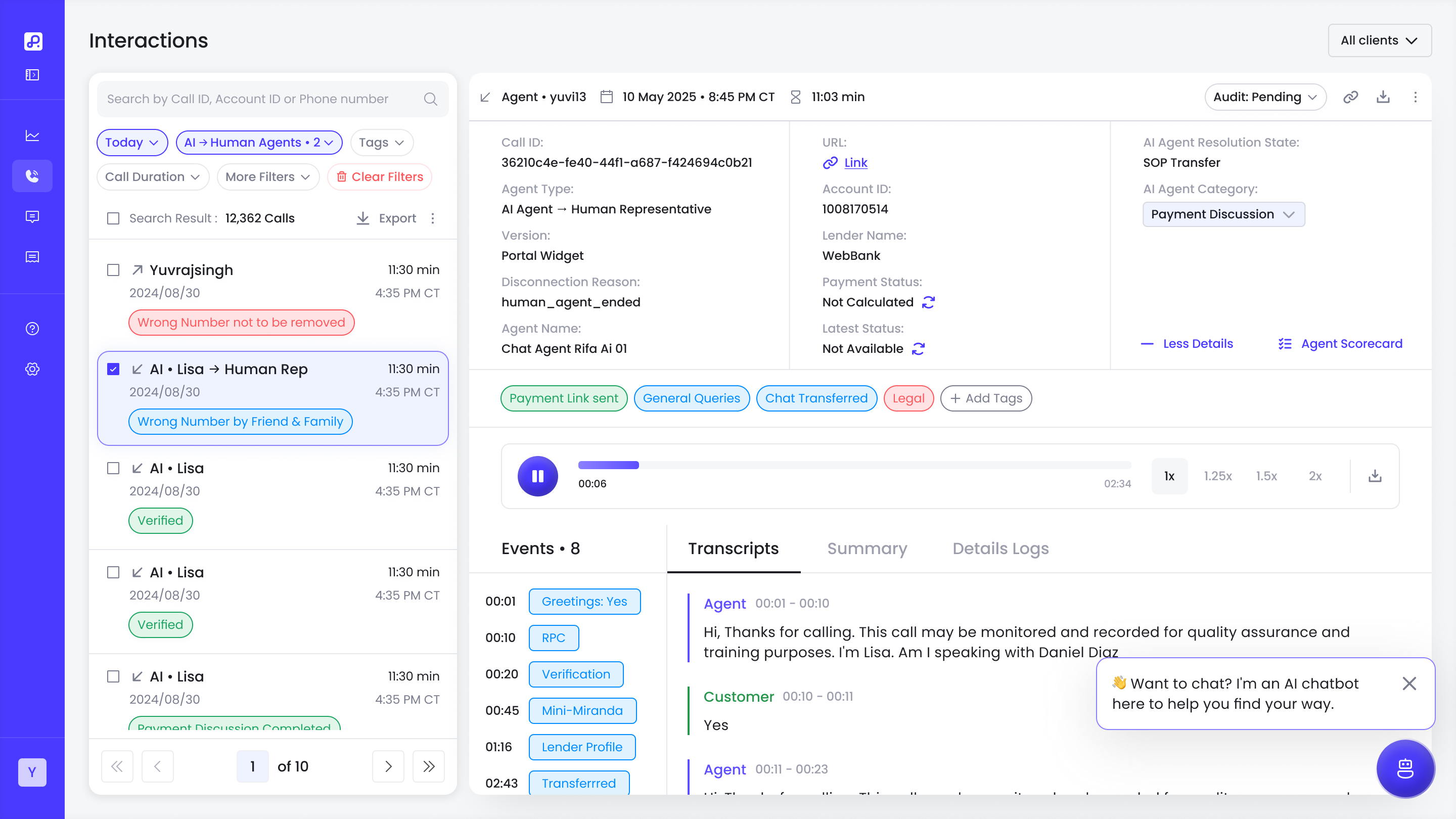
Two products, one platform. Talk to both.
Voice and chat, one brain, same guardrails. Try both below.
Three agents, each on two channels
Same agent, same guardrails, two channels. Start in chat, carry it into a call. Push it: ask for something out of authority, or say what should end the conversation.
Robin is calling from Northgate Financial about an account 34 days past due.
Voice agent
A creditor servicing its own account
Start the call and the live transcript appears here, turn by turn.
Chat agent
Same brain as the voice agent, over text
Verification, disclosure, then the account. Same order every time.
Four things holding that conversation together
Your SOP is the control flow
The procedure you already own becomes a step graph. The agent is always at a known step, and only the transitions defined for that step are available.
The harness bounds every turn
Disclosures, prohibited phrasing, and tool authority are enforced in code around the model, not requested of it in a prompt.
Context with provenance
Account state, consent, commitments, and prior assertions resolve before the agent speaks, each traceable to the system that owns it.
Exits the model cannot override
Cease and desist, dispute, attorney representation, and distress route to fixed handling paths wherever in the call they surface.
Where these agents are deployed
The platform is the same in each. What changes is the procedure, the obligation set, and the systems of record the agent reads and writes.
Debt collection
Right-party contact, disclosures, disputes, and payment arrangements inside FDCPA and Regulation F limits.
Healthcare
Patient access, intake, eligibility, and balance conversations with HIPAA-aware handling on every turn.
Insurance
First notice of loss, claim status, and renewals with prescribed scripts and defined escalation triggers.
Financial services
Servicing, verification, and hardship conversations where every call has to survive an examiner reading it.
Performs. Complies. Proves.
See Rifa AI handle a live collection call with required disclosures, smart escalation, and full audit trail. Then decide if your current system can keep up.