Collections calls that hold the rules on every account
Payment plans, account servicing and dispute triage, with FDCPA disclosures like the Mini-Miranda verified on every call.
- SOC 2 Type II
- ISO 27001
- ISO 42001
- HIPAA and BAA

- Containment rate
- 94.2%+
- Compliance pass rate
- 99.9%
- Throughput increase
- 3.2x
- Cost reduction
- 67%
In debt collection, every conversation is a compliance event
Scripts, disclosures and guardrails set by regulators have to hold on every call. Today that work is done by large human teams.
- 01
Every call is a compliance event
Disclosures, calling windows and consent are rules that hold on every call, not suggestions a model may follow.
- 02
Traditional QA reviews a sample
QA samples 1 to 2% of calls, so most calls are never checked. The regulator does not fine you on a sample.
- 03
Volume scales headcount
More accounts means more agents, training and attrition, and the result depends on who answers.

Every call scored. None sampled.
What the agent handles in debt collection
Each workflow is a section of the same Agent Operating Procedure (AOP), with its own tests and its own audit checks.
Servicing
Payment plans
Settlement offer, monthly or biweekly plan, card capture, read back before charging.
- Balance
- $486.00 · 12 days past due
- Offer
- 3 payments of $162.00
- Card capture
- Read back · confirmed
- Written to
- CRM and Reflect
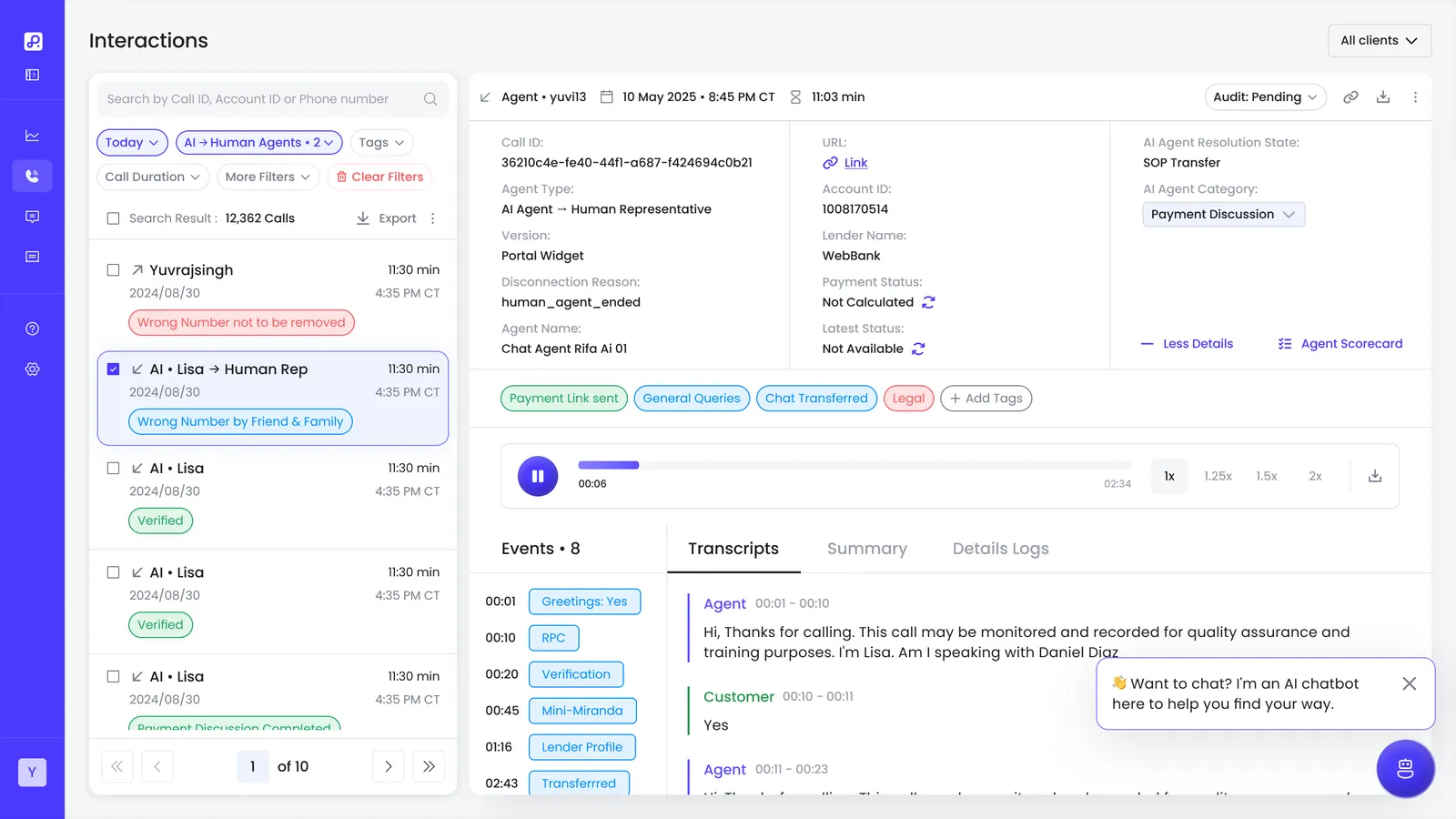
Checkpoints on this call
- Mini-Miranda
- Right-party verification
- Calling windows
- Recording consent
4 of 4checkpoints passed, written to Reflect
Don't read about it. Hear it.
Pick a situation and call the agent your customers would get. Accounts and names are fictional. Every call is recorded and scored in Reflect.
Rules the AOP encodes for collections
Every rule becomes a test. Nothing deploys until all pass. Reflect scores live calls on the same rules.
Visit the Trust Center- SOC 2 Type II
- ISO 27001
- ISO 42001
- AES-256 at rest
- TLS 1.3 in transit
- Mini-MirandaDelivered verbatim before any account detail, verified on every callTest · pass
- Right-party verificationIdentity confirmed before balance, plan or payment is discussedTest · pass
- Calling windows8am to 9pm local time, Reg F call-frequency limits enforced per accountTest · pass
- Recording consentCaptured and logged at the top of the callTest · pass
- Plan floorNever accepts an offer below the client minimumTest · pass
- Dispute and hardshipTransfers to a person with the reason attachedTest · pass
Debt collection questions
What the agent does on the call, what it will never do, and how you prove it afterwards.
Yes. It is a locked disclosure in the AOP, delivered verbatim before any account detail and verified on every call in Reflect.
Any window inside the FDCPA's 8am to 9pm default, resolved to the consumer's local time and set per campaign. Attempt limits follow Reg F's seven calls in seven days by default and can be set tighter per account. Every rule runs as a test before a version deploys.
The agent stops the payment conversation, records the dispute and its reason, pauses collection on the account and transfers to your disputes team with the transcript. The dispute and the transfer reason are written to your CRM and to Reflect.
Yes, within the limits you set. It states settlement and plan options from your system of record, never goes below the client minimum, reads card details back once and takes a verbatim authorization before charging through your payment APIs.
English today, with more languages on request. Every language runs on the same AOP, so the Mini-Miranda, the calling windows and the audit trail hold the same way.
Open Reflect. Every call has its transcript, recording, checkpoint results and disposition, searchable by account, agent or campaign. Because every call is scored, you show the whole population rather than a QA sample.
Performs. Complies. Proves.
See the platform handle a live call with required disclosures, a clean escalation, and the record to prove it.